
Introduction
The Sons of Norway has a 108 year tradition of providing the opportunity to learn and the encouragement to study your Norwegian heritage. Monthly programming is geared to enjoyment and learning of history, heritage and culture for the whole family. Parent and children will learn together about their Norwegian roots and continue the important work of passing from generation to generation their family heritage.
The finest Norwegian language camp is held at Skogfjorden near Bemidji MN each summer for students age 8-18. 1,2&4 weeks camps immerse students in learning about Norway.
Camp Norway held each summer in selbu Norway offers 16-23 years olds a unique opportunity to get to know Norway and Norwegian language while earning college credits. (link to S of N website)
Cultural activities, crafts, language, camps and other fun activities await. Get involved.
A SKOGFJORDEN SUMMER
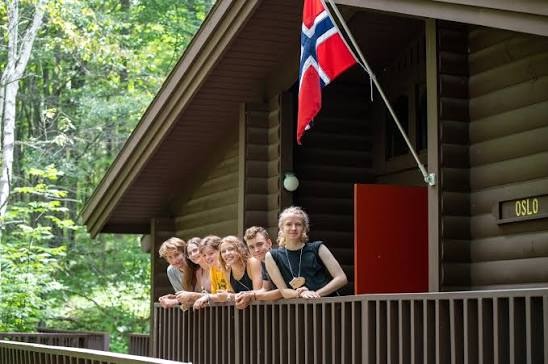
Kids immerse themselves in learning, adventure, and fun at this Norwegian Language Camp in northern Minnesota.
By Glenda Crank Holste
Photos courtesy of Concordia Language Villages
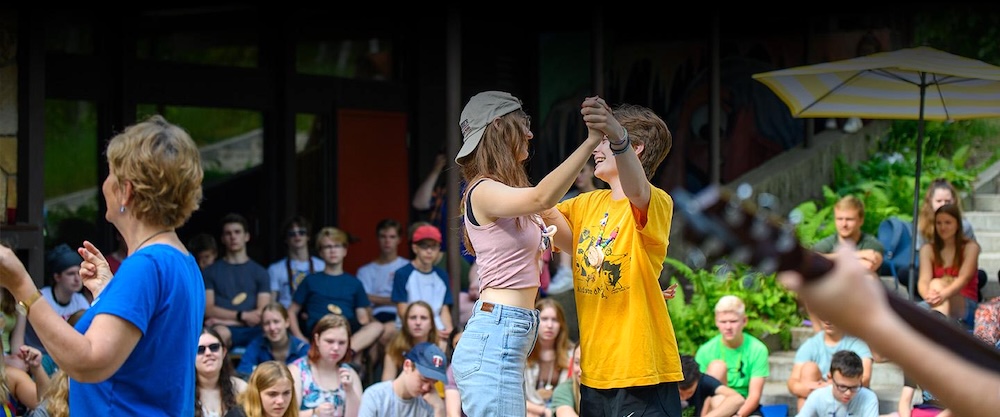
The midday summer sun makes lace from aspen shade on the forest floor. Woodsmoke's fragrance floats into the circle of singers along with the scent of risengrynsgrot (rice porridge) simmering in a cast-iron kettle behind the immigrants' small cabins. Time melts. Norwegians, first-generation Norwegian Americans, and children of great-grandchildren of Norwegians join hands and sing. They move left with the music, acting out the norsk lyrics to a song about laundering clothes. Kids in sneakers hear not just the words, but also how to make cultural music that carries history into contemporary learning. Adults, who have helped small hands craft nisser for this "first Christmas" on North America's frontier, encourage the adventure.
This is the scene at a summer camp in Minnesota. But it's no ordinary camp. Welcome to Skogfjorden (lake of the woods), the Norwegian village northeast of Bemidji that envelops young people into Norway's past, present, and future. Skogfjorden, which organizers refer to as a village instead of a camp, is a bright star in the renowned Concordia Language Villages' constellation of immersion programs. It also is an old friend to many Sons of Norway members.
From torsk fundraising dinners at local lodges to a substantial buy-in with money and sweat equity to begin building the permanent site in 1963, Sons of Norway has supported the village financially and has sent generations of young Norwegian-Americans to the splendid spot by Turtle River Lake in Northern Minnesota. In 1996-97, Sons of Norway contributed $37,400 to Skogfjorden in the form of scholarships.
In fact, Sons of Norway consistently is the largest single donor to Concordia Language Villages, says Liv Dahl, SON Foundation admisistrative director and Heritage Programs manager. Why does the investment in Skogfjorden by those interested in Norway continue to pay off?
Because Skogfjorden creates a Norwegian aesthetic. It provides an opportunity to step into Norwegian shoes to dance, sing, think, play, read, and work for a week, two weeks, or a month. It nurtures belonging in the larger world.
LANGUAGE LESSONS
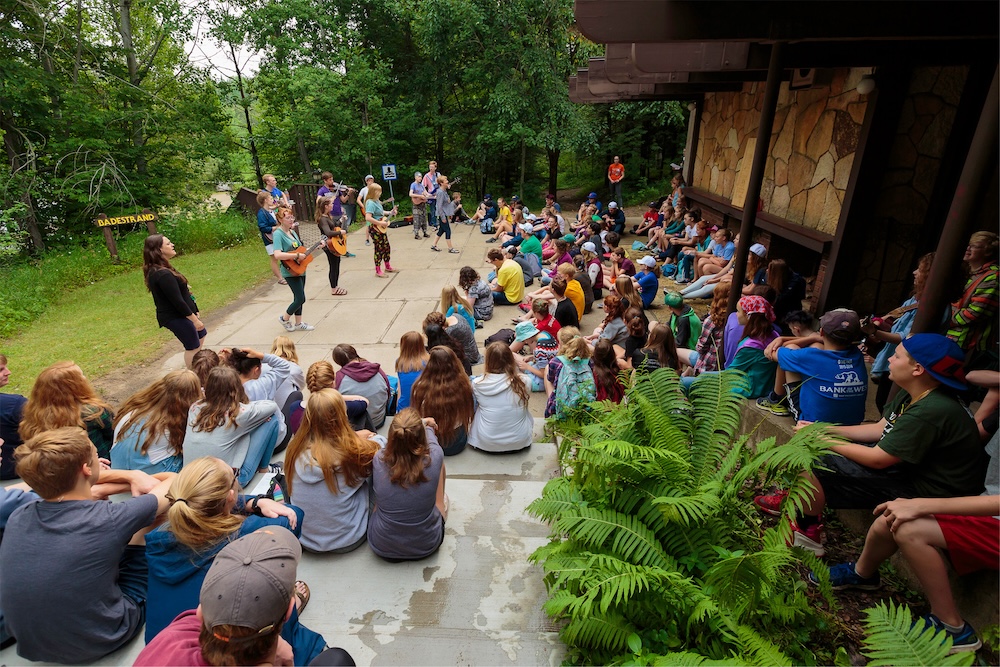 One August morning last summer, a breeze lifted a song about Skogfjorden from counselor Asmund Svensson's guitar and from young voices. If anyone remains unenergized even after breakfast, Allsang (group singing) remedies that. Kids catch the giggles acting out a song about a princess. Skogfjorden dean 'rove Dahl, (who is also Liv Dahl's daughter), translates for a visitor. The kids need nothing more than the context and camaraderie to clap and tap their way through a lightning-fast half-hour of music.
Singing at Skogfjorden also can reach others. Counselor Randi Buckley says evening programs at lakeside often come with a bonus; when Skogfjorden villagers sing in Norwegian, other language villages on Turtle River Lake sometimes add Swedish, Finnish, French, or German songs to the night air.
Norwegian is spoken everywhere at Skogfjorden. Along with pantomime, signs, and formal language instruction groups, it's a good bet that a child entering with a Norwegian vocabulary that stretches no further than a quaint "Uff-da" will leave two weeks later blurting out sentences of modern Norwegian.
The results are a product of planning follow-through, for which Tove Dahl credits her staff of about two dozen counselors, five food service professionals, and Concordia's personnel. "We create this hybrid culture,” she says. "We make Skogfjorden an ‘in
Between' place-in between the exotic and the familiar. By working in between, we increase the spectrum of the familiar."
Sessions last one week for young participants, two weeks for advanced and older children, a month for high-school credit courses. The language instruction is designed to to teach campers enough Norwegian to be able to function in Norway, Tove Dahl says. A first-year villager will learn language for basic survival skills. A second-year speaker will learn geography and build language skills. There are lessons for 10 years of study. Skogfjorden's "sister" program, Camp Norway, offers "grad school."
CULTURAL PERSPECTIVE
But language is not the only key to the program's success. My son Nelson, a two-year Skogfjorden veteran villager, says learning cooperation and enjoying new things are
equally as important as immersion learning, in making the institution click for kids. Nelson, who took the name "Peter" last year for village life, highly recommends the honey wheat bread (which we've made at home, too) the smoked salmon he tried there.
Skogfjorden is designed to affirm heritage of Norwegian Americans Norwegian Canadians and to expand the value of culture and language by encouraging ties to Norway today, Tove Dahl says. Toward that end, a lesson in the immigrant program at camp, called Fagertun, might expand on teachings about frontier Christmas activities with a discussion of what it means to be an immigrant. Villagers might be asked to consider how immigrants coming to Norway today might face challenges similar to those confronted by the Norwegian immigrants who built the very log cabins at Skogfjorden. The students learn how immigrants assimilate into other cultures while safeguarding their heritage.
Fagertun is one of four cultural programs in Skogfjorden's core curriculum. So is the timetravel simulation of Midtgard, named for the mythological Viking realm between the world of the gods and the world of men. In Midtgard, a grassy glen near Skogfjorden's entrance, woodcarvers might be working in the Viking-era surroundings, seated between a real stabbur (traditional Norwegian storehouse) and a replica of a stavkirke (traditional Norwegian wooden church).
This is a place of imagination and even romance. Staff counselor Randi Buckley tells how she was married on Midtgard's lawn. She says Skogflorden has been a special home for her, a constant for a young person raised in a military family that moved frequently. Hence, Skogfjorden was a logical choice for the six-year villager and eight-year staffer as the site of her wedding to a fellow counselor.
A third core program teaches about modern living in Norway. Last year's program at Soltun was school time, and it included, among many es, a physical education program similar to those typical for middle-school students in Norway. The fourth core program, called Jotunheiinen, focused on science and outdoor living by taking advantage of Skogfjorden's natural surroundings.
Through those cultural programs, villagers experience both Norway's past and present. The combination clicks with villagers. Between 60 and 70 percent return to Skogfjorden after their first session. Most students come from a Norwegian family background; "Norge" shirts and blond hair are right at home.
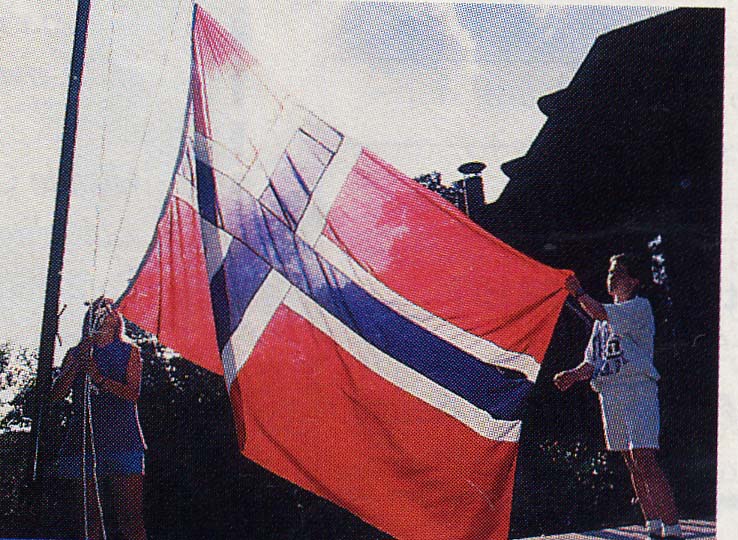
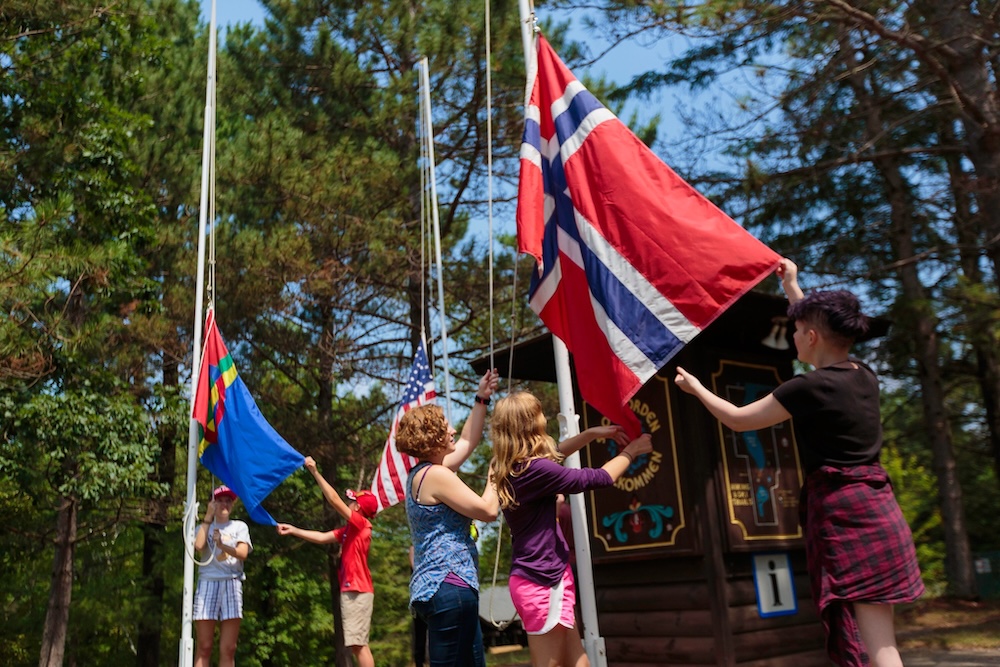
Each day at Skogfjorden begins with a flag raising.
A LOYAL FOLLOWING
Kristen Johnson of Shoreview, Minnesota, admits she first attended Skogfjorden in 1981 to please her grandmother. Now, she has attended for 16 years. Johnson answered to her village name "Eva" when kids gathered by the beach on a perfect, cloudless summer morning last year.
Johnson, a graduate of Augsburg College in Minneapolis and a Skogfjorden counselor now, says her experience is fairly typical. Kids come to Skogfjorden because a grandparent or parent wants them to get a taste of their Norwegian heritage. Then the kids learn that, by golly, village life is fun.
Even Tove Dahl admits she had to be coaxed to attend the village her first year when she was apprehensive about a new experience away from home. Her concerns vanished within minutes of meeting other girls in her cabin, and her 26-year adventure had begun.
Skogfjorden remains an adventure for young villagers of the '90s. For instance, Sigrid Espe of Woodbury, Minnesota, told members of Vonheim lodge 1-108 in Minneapolis at a December gathering "I enjoyed myself very much [last summer at Skogfjorden]. We would raise the flag and sing the national, anthem. The meals were just delicious. We would sit by the fire at night or go for hikes."
Her brother, Alex Espe, gives a telling assessment of the village: “Once camp is over, you feel like you've been in Norway. I missed it when it was over.” The same sentiment, expresses under the August sun at the end session, came from "Elin," known as Ashley Ahlbrand outside the gates of Skogfjorden. She was finishing woodwork in a swirling Viking motif on the last day of camp. "It's sad to leave your new friends so soon," she says. Til i summer...